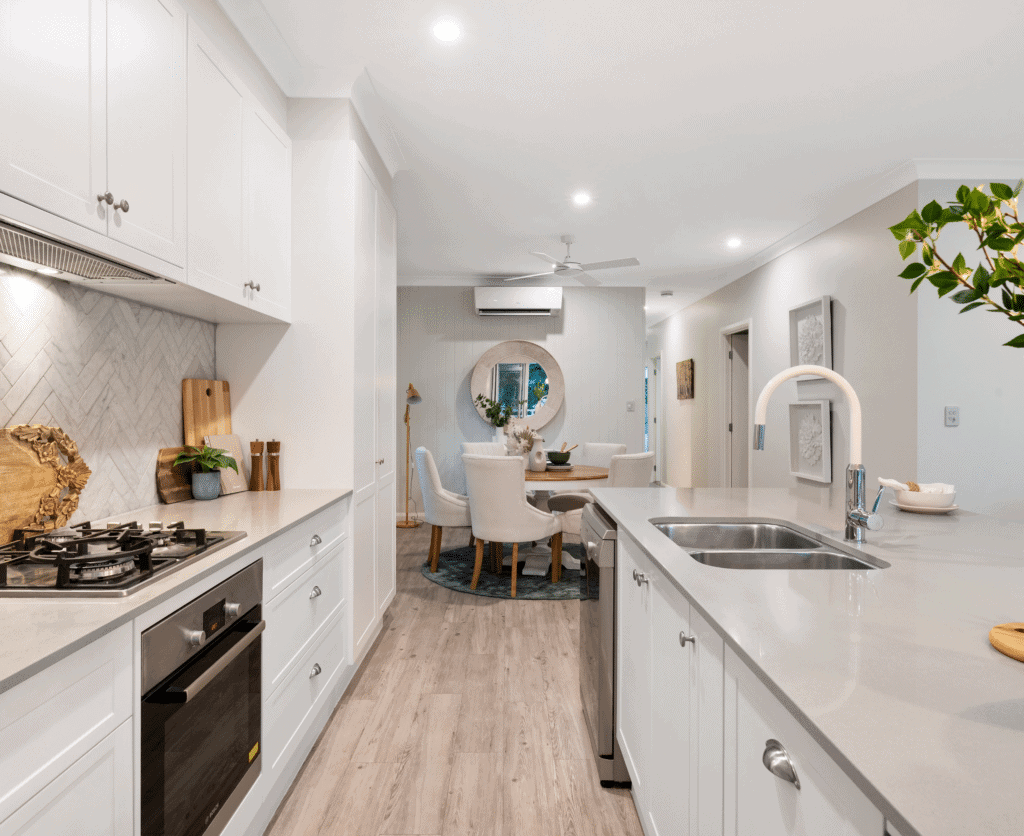
More homes sold across Greater Victoria this August than in any August in the past five years. At the same time, the benchmark price for a single-family home in the Victoria Core edged lower.
At first glance, those two trends may seem contradictory. More sales are usually associated with stronger competition, which can put upward pressure on prices.
But August is a good example of why sales numbers rarely tell the whole story.
The missing piece is inventory.
Sales improved, but buyers still had plenty of choice
A total of 591 properties sold across the Victoria Real Estate Board region in August 2026, up 12.6% from the 525 sales recorded in August 2025.
Single-family home sales increased 15.3% year over year, while condominium sales increased 15.1%.
At the same time, there were 3,662 active listings on the MLS® at the end of August. That was only 1.7% higher than a year earlier, but it still represents a healthy level of inventory for buyers to choose from.
That combination helps explain what we are seeing in the market.
There are buyers actively making moves, but in many segments they have enough choice that they do not need to rush into a property simply because it is available.
The Victoria Real Estate Board continues to characterize the broader market as balanced, with buyers remaining selective and well-priced, well-presented homes attracting the strongest interest.
For sellers, that distinction matters.
A balanced market is not an inactive market. It is a market where buyers are more able to compare one property against another, consider value carefully and take the time to make a decision.
More sales did not mean homes suddenly sold faster
Another useful number from August is days on market.
Single-family homes took approximately 46 days to sell on average, essentially unchanged from August 2025.
So while more buyers completed purchases this August than last August, the overall pace remained relatively measured.
For someone preparing to sell this fall, it is worth building that into expectations. A successful sale does not necessarily mean receiving an offer in the first few days.
Depending on the property, neighbourhood and price range, several weeks on the market can be entirely consistent with current conditions.
Why the July-to-August sales decline needs context
August sales were down 12.2% from July, which may sound more concerning when viewed on its own.
But real estate is seasonal, and month-to-month comparisons can be particularly misleading through the summer. August has historically been a quieter month for real estate activity in Greater Victoria as vacations and the approaching school year affect both buyers and sellers.
The year-over-year comparison provides useful additional context.
Compared with August 2025, total sales increased 12.6%. In fact, the Victoria Real Estate Board noted that August 2026 produced the strongest August sales activity in five years.
That does not mean the market is accelerating across every property type or neighbourhood. It does suggest that the decline from July should be viewed as part of the broader seasonal picture rather than as evidence, on its own, of a weakening market.
What happened to Greater Victoria home prices?
Despite the increase in sales, benchmark pricing remained relatively steady to slightly lower in the single-family segment.
The MLS® Home Price Index benchmark for a single-family home in the Victoria Core was $1,301,800 in August. That was down 0.6% from $1,317,200 in August 2025 and down from $1,311,000 in July.
That is a fairly modest movement, but it reinforces the broader theme of the market.
More transactions have not translated into significant upward pressure on single-family home values.
Higher-value properties can be particularly sensitive to this environment. Buyers at the upper end of the market often have a smaller pool of comparable properties to work with, but they may also have greater flexibility around timing and a wider geographic search.
That makes neighbourhood-level and property-specific analysis especially important. The Greater Victoria market can be balanced overall while individual price ranges and neighbourhoods behave quite differently.
A high sale-to-list ratio does not always tell the whole story
Another statistic worth understanding is the sale-to-list price ratio.
A home selling relatively close to its asking price can sound like clear evidence of pricing strength. But there is an important distinction: the ratio is generally measured against the asking price in place when the property sells, rather than necessarily the price at which it originally entered the market.
Consider a hypothetical home that initially lists at $2.25 million, spends time on the market, is eventually repositioned at $1.9 million and then sells for $1.85 million.
The final sale can appear quite close to asking price even though the seller ultimately accepted substantially less than the home’s original list price.
That does not make the statistic misleading. It simply means it needs context.
For sellers, the more useful question is not only, How close are homes selling to asking?
It is also: What happened between the day those homes were listed and the day they sold?
Price adjustments, days on market, competing inventory and changes in buyer response all help complete that picture.
What does this mean if you are selling this fall?
August provides a fairly encouraging signal for sellers in one respect: buyers are participating in the market.
But those buyers also have choices.
That makes the initial positioning of a property particularly important. Pricing based on current comparable sales and competing listings can help a home enter the market in a range buyers recognize as reasonable.
This does not mean every home needs to be priced aggressively or below market value. Nor does it mean a property that takes several weeks to sell has been positioned incorrectly.
It means sellers should be cautious about relying on a strategy of deliberately starting well above the evidence and assuming buyers will negotiate from there.
When buyers have alternatives, some will negotiate. Others will simply choose the property they believe represents better value.
Condition and presentation matter as well. VREB noted in its August update that well-priced and well-presented homes continue to attract the strongest interest.
What does this mean if you are buying in Greater Victoria?
For buyers, the current market offers something that was difficult to find during the lowest-inventory years: time to make a more considered decision.
There is meaningful sales activity, but inventory remains healthy enough that many buyers can compare properties and complete appropriate due diligence without the same level of urgency that characterized the pandemic-era market.
That can be especially valuable if you are relocating to Greater Victoria.
Price is only one part of choosing an area. Spend time understanding what the neighbourhood will actually feel like once you live there. Walk it during the week. Test the commute during rush hour. Compare access to schools, recreation, shops and the places you expect to use regularly.
The additional choice in today’s market can give buyers more opportunity to make those comparisons before committing.
The August market in one sentence
Sales were stronger than they have been in August for five years, inventory remained healthy, and single-family benchmark prices were relatively steady to slightly lower.
That is not a booming market, and it is not a market in freefall.
It is a relatively balanced market where buyers are participating but still have choices, and where sellers benefit from being thoughtful about pricing, presentation and how their home compares with the competition.
If you are considering buying or selling in Greater Victoria this fall and would like to understand how these broader numbers translate to your particular neighbourhood, property or price range, we are always happy to help you look at the details. Contact us.
North Pacific Homes Group, eXp Realty
Greater Victoria & South Vancouver Island
250-634-2141
Thanks for being here,
Alex Hughes, REALTOR®, Personal Real Estate Corporation — North Pacific Homes Group (eXp Realty) | Victoria, BC Real Estate
Ricki-Lee Jewell, REALTOR® — North Pacific Homes Group (eXp Realty) | Victoria, BC Real Estate
Steven Reilander, REALTOR® — North Pacific Homes Group (eXp Realty) | Victoria, BC Real Estate